Climate Coffee brews up world’s first carbon-negative roasting process
By Kaileen Gruber, Laramie Boomerang | August 15, 2026
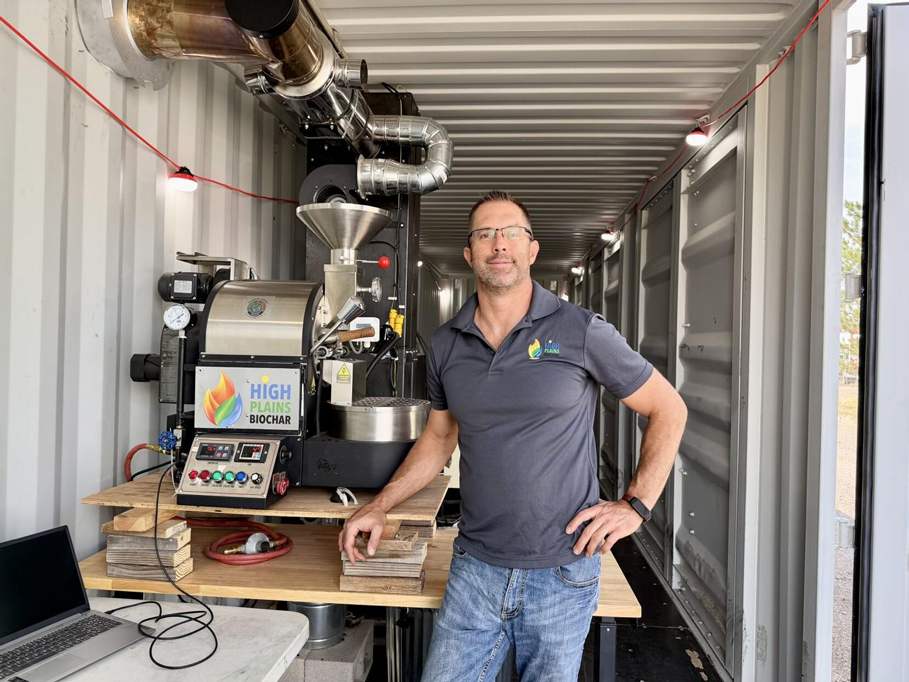
A Laramie company is transforming the daily caffeine fix into a climate solution.
Climate Coffee, created by High Plains Biochar LLC, has developed what it calls the world’s first carbon-negative coffee roaster. Founded by Owner and CEO Rowdy Yeatts, the company specializes in carbon-negative technology.
The process begins locally with used coffee grounds collected from Starbucks Coffee Company, Turtle Rock Coffee & Cafe and Night Heron Books & Coffeehouse. The solar-powered operation dries the grounds and heats them to produce fuel for a specialized roaster. Energy from that fuel is then transferred to the roasting chamber to process the next batch of beans.

The process leaves behind a carbon-rich biochar that can be returned to the soil to help grow future coffee plants.
“It’s a stable form of carbon that doesn’t go back into the atmosphere,” Yeatts said. “Normally, the coffee plant pulls carbon out of the atmosphere, grows itself into limbs, leaves, all that stuff, and then just decomposes and release it back into the atmosphere. But we’ve turned it into a really stable form of carbon that doesn’t come back.”
While its technology has expanded globally, Yeatts is currently focusing on growing the brand in the United States while prioritizing the broader decarbonization process.
“We sold one of our technologies to a group out of the Netherlands last year. We have stoves all across Ghana and all across Africa. We’ve trademarked the name in about 40 different countries across Europe, Asia, Australia, even over in Iceland,” Yeatts said.
“But in the U.S., we hadn’t been able to figure it out, until this. We figured out that if we can take something that people are already doing, drinking coffee, and then we decarbonize that process for them. We’ll be able to decarbonize the farms end of it as well to help the supply chain.”
The roasting method also benefits the flavor of the coffee, according to the company.
“Where they would traditionally be using a propane flame heating the drum up, we’re pulling hot air through the process. What that means is we get a better flavor profile in our coffee because the direct heat could cause scorching and uneven cooking of the beans, and the indirect heat makes a more even cook,” Yeatts said.

High Plains Biochar is now looking toward broader expansion and consumer reach.
“We have big plans for what we want to do here. We believe that there’s a percentage of people who drink coffee that care a lot about the environment and the climate, and that if they have a choice on what cup of coffee, whether it’s a Starbucks, Dutch Brothers, McDonalds, whatever, if they have a choice on it, we think that there’s people that will do that,” Yeatts said.
“Ideally, our goal is to turn this into the largest coffee company in the world.”
For more information about the process, the roaster, and partnering with Climate Coffee, visit climatecoffee.shop.
Comments